
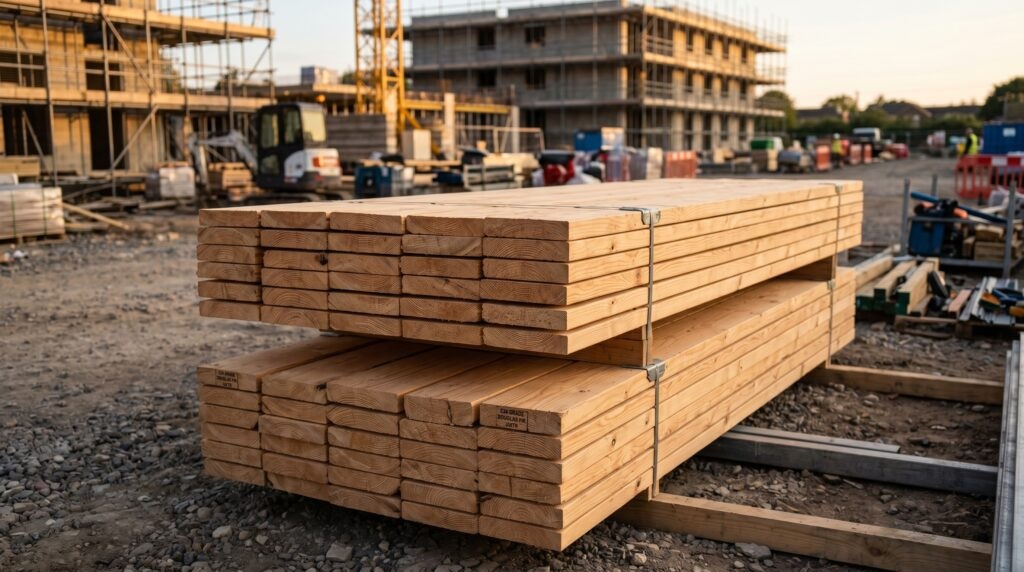

Treated pine keeps getting the big outdoor jobs not because it’s the cheapest product available but because it’s the product that most consistently marries cost to performance across hazard classes, service life, and the supply chain. Builders treating “cost-effective” as a question of what comes off the end of the roll docket pay again for quoting jobs with premature timber failure or a premium alternative that blew out their labor budget. But you can’t understand the economics without knowing what treated pine is actually rated to do.
Start with the hazard class, not the price tag
Any cost discussion about treated pine must focus on the hazard class framework outlined in AS 1604.1. H3 is meant for above-ground purposes where the wood is exposed to the weather but not in contact with the soil – for instance, fencing, fascia, and pergola beams. H4 is for in-ground use where moisture and soil organisms are present at all times – for example, retaining walls, posts, and landscaping edges. H5 is for high-risk in-ground and structural applications where potential failure would be very expensive or hazardous, such as load-bearing posts in aggressive soils.
The treatment level determines the cost-effectiveness since a piece of H3 timber used in the place of H4 will appear good for a couple of years followed by internal rotting. At that time, the original price will not be of any significance. Instead, the project will pay for it twice – first to purchase the wrong material, second to remove and replace it. For any large external project, the first and foremost cost-effective decision to make is which treatment level to use, and in this regard, treated pine simplifies things since its grading is standardized and clearly indicated on the timber.
The upfront numbers, and why they only tell half the story
On a straight per-linear-metre comparison, treated pine consistently comes in at roughly half the cost of premium hardwoods like jarrah, blackbutt, or spotted gum. Composite decking sits even higher again, often two to three times the material cost of treated pine before installation labour is factored in.
That gap is real and it’s the reason treated pine dominates landscaping supplies and builder’s merchants’ outdoor timber sections. But sticker price is a poor way to compare materials that are expected to last decades. The better metric is cost per year of service life: total installed cost, divided by how long the material is realistically expected to perform without major repair. An H4-treated retaining wall built to run 25-30 years in-ground can cost less per year of service than a hardwood alternative that looks nicer on day one but needs staining, sealing, or partial replacement well before it hits the same age.
Why pine takes treatment better than most hardwoods
The reason treated pine acts the way it does turns out to be a technical detail of the timber itself, rather than the chemistry. Radiata pine sapwood – the only bit that is typically treated for in-ground use – has an open, permeable cellular structure.
When you put it through a pressure treatment cycle, the preservative doesn’t just sit on the surface: it penetrates through the full cross-section of the board. For builders managing large-scale jobs across Perth, working with a dependable local source such as Treated Pine Timber Supply Perth ensures consistent H3/H4/H5 stock levels and mill-direct pricing across the whole project timeline. Cut it in half and the treatment is still there in the middle, not just around the edges.
Many hardwood species are far denser and more resistant to penetration… which means treatment on hardwood often ends up as a surface coating rather than a full-depth cure. That’s part of why hardwood durability in outdoor use depends so heavily on species selection and heartwood content rather than treatment, and why some hardwoods rely on natural density and oil content instead of preservative penetration at all. Pine’s sapwood structure is a manufacturing advantage other species simply don’t have.
The preservatives have changed, and that’s worth knowing
Older treated pine used Chromated Copper Arsenate (CCA), which was phased out of residential applications in Australia back in 2004 over health and environmental concerns. Today’s treated pine uses water-based preservatives like Copper Azole (CA) or ACQ, which offer the same protection against fungal decay and termite attack without the arsenic content of the old formulation.
This matters for two reasons. First, it means anyone comparing “treated pine” against memories of older decking is working from outdated information – the product has moved on. Second, it means treated pine sits more comfortably in projects with environmental or health sensitivities, including parks, schools, and residential landscaping where CCA-treated timber would raise questions.
Termite resistance without the hardwood premium
Termite pressure poses a real structural threat in most of Australia and is one of the commonest reasons people cite for specifying hardwood over pine. In practice, however, pine does well if the ends and holes of cut beams and joints are liberally painted with an appropriate insecticidal preservative. And the fact that builders and installers can always skip this step is also the single commonest reason pine fails to perform on a building site – not an inherent flaw in the product.
Where H4 or H5 is specified, treated correctly and again treated in the field on cut surfaces it will outperform untreated hardwood under most low and medium pressure situations and match or even outperform untreated hardwood in a high-pressure zone. The key is in the detail and the only real question is whether your crew will continue to observe the small detail of treating every exposed cut or plonk down what looks easier and worry no more about it.
The sustainability angle that’s starting to matter on tenders
Radiata pine accounts for 76% of Australia’s softwood plantation estate, which is roughly 800,000 hectares, so it’s our largest structural timber resource (ABARES, Australian Plantation Statistics). But the size of that plantation estate is also significant in terms of what it represents – almost all of our treated pine comes from plantation, not native forest harvest.
That’s a big deal when your alternative species for outdoor use are more likely to be native forest products, as is often the case with hardwood. If you’re working on a project meeting green building criteria or that has ambitious sustainability targets, the source of timber products comes under the microscope. In some public or tendered projects, or in developments where you need to provide an environmental product summary, it’s just easier to specify plantation-grown treated pine. FSC certs are available for those jobs that need the proof as well.
Labour and workability savings that don’t show up on the quote
Material cost is only part of the total installed cost, and this is where treated pine quietly wins jobs that look close on paper. Pine is significantly lighter than hardwood, easier to cut, and far less punishing on blades and drill bits. On a large retaining wall or fencing job involving hundreds of linear metres, that difference compounds fast – faster cutting, less tool wear, less crew fatigue, and less on-site wastage from split or damaged boards during handling.
Dense hardwoods slow everything down. They blunt blades quicker, need pre-drilling for most fixings, and are heavier to move and position, which adds time and sometimes extra people to a task pine handles with one. None of that shows up as a line item on a material quote, but it shows up in the labour invoice at the end of the job.
Composite decking: the real counter-argument, addressed honestly
Composite decking deserves a fair hearing. It doesn’t need painting or staining, it resists splintering, and it holds up well in moderate climates. Those are genuine advantages for homeowners who want to avoid ongoing maintenance.
The trade-off is cost and climate performance. Composite carries a much higher upfront material price, and in harsh Australian UV exposure, some composite products still cup, fade, or expand and contract more than expected over time, sometimes requiring partial replacement well inside a 20-year window. Treated pine, with a periodic re-oil or reseal every few years, tends to stay cheaper over that same horizon even accounting for the maintenance labour. For large-scale projects where the client is watching total spend rather than chasing zero-maintenance convenience, that difference is usually decisive.
Paying for grade to protect the budget
There is a price difference in the quality of treated pine you buy. On very large jobs it’s better to pay the slightly higher price for select or machine-dressed grades, rather than automatically going for the cheapest structural grade. The visual grades have fewer and smaller knots, straighter runs, and more consistent dimensions reducing wastage and rework in fabrication. On a project involving thousands of linear meters, the extra couple of dollars per meter the better grade costs can pay for itself several times over as you slash the number of boards rejected on site.
Why supply reliability is a cost factor too
Schedules for large-scale projects are based on predictable material flow, and treated pine has a structural advantage over some hardwood options in this area. Certain hardwoods are harvested intermittently and are quota or seasonally constrained, which can either have your project waiting on stock or shelling out for high-cost rush orders. Milled from plantation resource and thus available year-round – treated pine doesn’t pose the same risk.
That consistency protects the schedule, and a protected schedule is a cost saving in itself which rarely makes it on to the ledger but is always noticed where it’s lacking.
The bottom line for large jobs
Cost-effectiveness in a major outdoor project comes down to more than comparing the cheapest initial price per linear meter. It’s about matching hazard class to application, comparing total cost over the real service life, and building in a supply chain that won’t stall the job halfway through. Treated pine wins that comparison consistently, not because it’s the flashiest material on the yard, but because it holds up on every metric that actually determines what a project costs from first delivery to final year of use.

Comments are closed.