
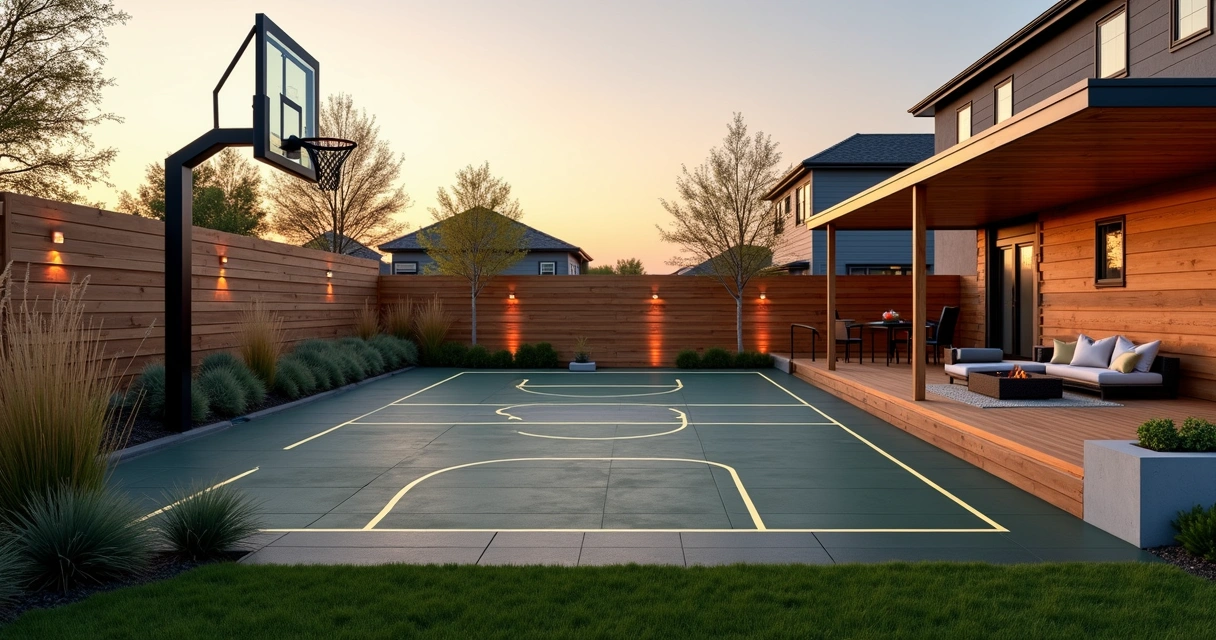

Many homeowners think that in order to have a multi-sport court you need a huge backyard. This is not true. If you optimize the layout of the court and carefully select the right equipment you can easily fit a court in your backyard or driveway. Think about the following four decisions when planning your court.
Commit to the 30’x50′ footprint, not a bigger dream
Official pickleball court dimensions are 20 feet by 44 feet (USA Pickleball). If you want to compromise on those dimensions, that’s fine. However, set it up less than 30′ x 50′ and you’ll never get more than a handful of hobbyists using it at a time. One of the most beautiful aspects of any multi-sport court is letting two different games happen at once, and that won’t be possible on a 25′ x 45′ slab. Running off the dimensions just isn’t practical if you want regular use from the age-7-to-70+ crowd.
Don’t cut corners on grading and drainage
The step homeowners underestimate most is the one that ultimately determines whether your court lasts fifteen years or five. Small pads are more vulnerable to water damage, as there’s simply less surrounding land to help absorb water and runoff. Desert soil compacts and shifts differently than clay or loam, and monsoon-season flash flow can pool against a slab edge and upend the subbase within a single season if the grading is off by even an inch. Once that subbase shifts, cracks tend to follow the same path year after year, and by the time they’re visible on the surface, the damage underneath is usually already extensive and far more expensive to correct than it would have been to prevent.
Good site-prep is slope away from the court, a properly graded aggregate or poured concrete subbase matched to your soil type, and perhaps even a shock pad underlayment beneath the acrylic surface to minimize joint strain. And it’s utility locating before any excavation as well since gas, electric, and irrigation lines are often closer to the house than people expect. Which is exactly why an experienced court builder in Scottsdale Arizona matters more on a small lot than a large one. A contractor who knows the local soil behavior, setback rules, and permitting quirks will catch problems before the concrete gets poured, saving you from costly rework and giving the finished court a far better chance of holding up season after season.
Layer your line striping instead of building separate courts
The natural solution would be to have multiple slabs or else a court that’s partitioned off in some way. But you don’t need to have two. A single slab can easily handle three sets of boundary lines if you create distinctive enough paint colors and color combinations. Paint the pickleball lines in white, the basketball boundaries in yellow, and the volleyball or badminton lines in blue. Include a small painted color key in the vicinity of the court so that new guests aren’t standing around squinting trying to determine which lines they’re supposed to follow. This is already standard for multi-use courts, and it works well simply because the human eyes can more quickly differentiate between colors than they can between sizes of lines or line dashes. Just resist the urge to pick out similar shades. If two of the lines are closer to green or closer to gray, folks will inevitably get them confused mid-game.
Fence it and orient it right
Two more things distinguish a good court from an annoying one next door. First, put ball-stop fencing at 10 to 12 feet on two sides at least. On a tight court like this one, balls quickly sail into a neighbor’s yard so you need to contain them. Second, orient the court north-south, not east-west. Arizona’s late afternoon sun is low and intense and a poorly oriented court makes every evening game a contest of squints. LED pole lighting (smaller than regulation tower fixtures) makes evening games possible without glare or industrial-scale lighting.
Bringing it all together
A great multi-sport court isn’t about square footage, it’s about smart decisions made early. Lock in the 30′ x 50′ footprint, invest in grading and drainage before anything else, layer your striping thoughtfully, and fence and orient the court with your neighbors and the Arizona sun in mind. Get those four choices right and even a modest backyard or driveway can host pickleball, basketball, and volleyball for years without a single costly surprise. Skip any one of them, and you’re gambling with a project that’s expensive to redo.

Comments are closed.